

A Real-World Example of Business Continuity in Healthcare
One of my healthcare clients experienced something they never expected.
After hours, a truck drove into the side of one of their medical offices.
Thankfully, no one was inside.
By the next morning, however, the practice was facing a different challenge. The building had been damaged, employees couldn’t safely work from the office, and patients still needed care.
The appointments didn’t stop.
The phone calls didn’t stop.
Most importantly, patient care didn’t stop.
The question became…
Was the practice prepared to continue operating?
Fortunately, this wasn’t something they were trying to solve for the first time during an emergency. We had already worked together to build a communication strategy that could continue supporting the practice if something unexpected happened.
Calls were quickly redirected to another location while employees answered calls using secure mobile applications on their cell phones. Staff immediately began contacting patients to reschedule appointments where necessary, while patients needing immediate care were redirected to another practice location that could continue seeing them.
The practice also had a redundant internet connection in place. Although one circuit was affected by the accident, the backup connection allowed critical services to continue operating once power was restored. While repairs to the building continued, employees were able to return to work much sooner because the technology supporting the practice had already been planned for situations like this.
Within a day, the practice was largely back to normal. Construction crews continued repairing the building over the following weeks, but patients were being cared for, appointments were being managed, and the practice continued serving the community.
After the situation was over, the practice manager told me she couldn’t imagine handling that day without the communication strategy we’d already put in place. Instead of spending days catching up, the staff was able to continue working, patients were contacted and rescheduled quickly, and the practice avoided a backlog that could have affected patient care long after the building was repaired.
Patients would have continued arriving for appointments with no way of knowing the practice couldn’t see them that day. Instead, the staff were able to quickly contact patients, reschedule appointments, redirect emergencies to another location, and continue answering calls remotely.
When preparation is done well, patients rarely see the emergency. They simply experience a practice that continues to care for them.
Even the headquarters servers remained accessible to the practice’s other locations, allowing day-to-day business to continue instead of creating a backlog that could have taken days to recover from. Employees were able to continue supporting the organization behind the scenes, even while the building itself was being repaired.
Unexpected Interruptions Happen More Often Than You Think
Most healthcare organizations will never experience a truck driving into the side of their building.
But unexpected interruptions happen more often than people realize.
- Internet outages
- Utility interruptions
- Construction crews accidentally damaging nearby services
- Equipment failures
These situations are usually temporary, but without a plan in place they can quickly become much larger disruptions for both your staff and your patients.
Preparation Starts Before the Outage
One of the biggest conversations I have with healthcare organizations isn’t about what to do during an outage.
It’s about making sure they’ve already planned for one.
The best continuity plans are usually the ones that never have to be tested because they were created long before an unexpected interruption occurred.
During technology assessments, I often encourage healthcare organizations to ask themselves a few simple questions.
Questions Every Healthcare Practice Should Ask
- If your internet provider experiences an outage, what happens next?
- If employees can’t work from the office, can they continue answering patient calls remotely?
- If one location experiences an issue, can another location temporarily support patients?
- Does everyone on your staff understand the plan, or are those decisions being made during the emergency?
These aren’t questions most healthcare organizations think about every day, and that’s understandable. Their focus is exactly where it should be: providing excellent patient care. That’s where technology should quietly do its job, supporting your team so they can continue focusing on what matters most.
Taking time to answer those questions before they’re needed can make the difference between a temporary inconvenience and an interruption that affects your patients, your staff, and your daily operations.
Technology Should Support the Plan
One of the biggest misconceptions I encounter is that business continuity simply means purchasing a second internet connection.
In reality, redundancy is only one piece of the strategy.
The technology itself isn’t the plan.
It’s what supports the plan.
Redundant internet connections, cloud phone systems, mobile applications, intelligent call routing, and other communication tools work together to keep your practice operating when something unexpected happens.
Every Healthcare Organization Has Different Needs
One healthcare organization may only need a simple backup internet connection.
Another with multiple locations may benefit from routing calls between offices, allowing employees to answer calls securely from mobile applications, or creating communication plans that help staff know exactly what to do when an interruption occurs.
Every healthcare organization is different.
The goal isn’t to recommend the same solution for every practice.
The goal is to make sure your technology supports the way your practice delivers patient care.
Technology continues to change and enhance the way healthcare organizations operate. New communication tools continue to make it easier for practices to stay connected, support employees remotely, and minimize disruptions when unexpected situations arise.
Keep Patient Care Moving Forward
The goal isn’t to prepare for unlikely disasters.
The goal is to make sure everyday interruptions have as little impact as possible on your patients and your staff.
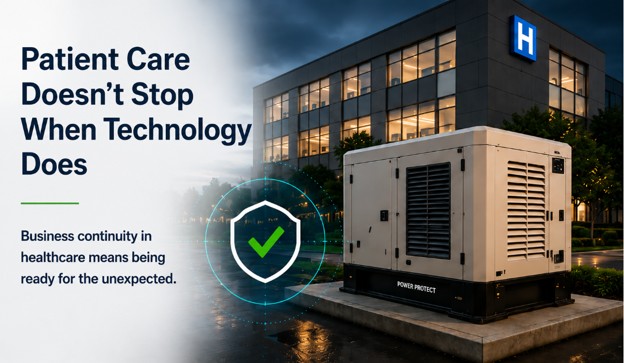
Because patient care doesn’t stop when technology does.
Ready to Evaluate Your Business Continuity Plan?
If you’re unsure how your organization would respond during an unexpected outage or emergency, let’s talk. A complimentary technology assessment can help identify opportunities to improve communication, increase resilience, and keep patient care moving—no matter what happens.