During the height of COVID, one OBGYN clinic I worked with experienced tremendous growth. Let’s just say people were spending a little more time at home, and the practice certainly noticed. At the same time, healthcare organizations were adapting to new communication expectations, additional precautions, and an overwhelming increase in patient calls.
As the practice continued growing, so did the demands placed on the front desk.
They expanded their phone system until all nine menu options were being used. Three of those options existed simply to separate appointment-related calls because the volume had become so overwhelming.
At first glance, it looked like they had a phone system problem.
They didn’t.
The phone system wasn’t the problem. It simply revealed a workload that had outgrown the tools the practice was using.
The staff wasn’t struggling because they lacked effort.
They were spending an increasing amount of their day answering repetitive phone calls, confirming appointments, transferring patients, and managing communication that had grown far beyond what the practice originally needed.
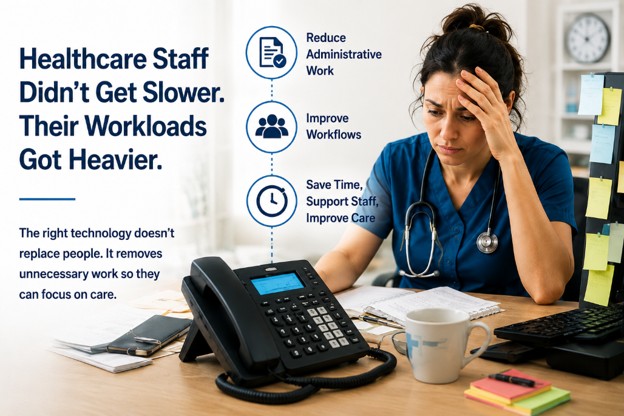
Healthcare staff didn’t get slower.
Their workloads got heavier.
Healthcare Communication Has Changed
As healthcare has evolved, so has the amount of communication expected from every practice. Patients still call, but they also text, complete online forms, request appointments through websites, expect appointment reminders, and want quicker responses than ever before.
None of those expectations are unreasonable.
But together, they create a tremendous amount of administrative work that didn’t exist for many practices years ago.
The challenge isn’t finding employees who work harder.
The challenge is giving the employees you already have the tools to spend more of their time helping patients instead of managing repetitive tasks.
Finding Where Staff Time Was Going
For this practice, adding more staff wasn’t necessarily the best solution.
Instead, we looked at where their time was actually going.
The practice implemented a contact center with callback capabilities, allowing patients to keep their place in line without remaining on hold. Website appointment requests gave patients another convenient way to schedule care without immediately calling the office. Text messaging and automated appointment confirmations reduced the amount of time employees spent making routine reminder calls, allowing them to focus on scheduling patients who actually needed assistance.
The Result Wasn’t Fewer Employees
It was more productive employees.
Staff members had more time to answer questions, assist patients, and manage the situations that genuinely required a person instead of repetitive administrative work.
Patients also benefited.
They spent less time waiting on hold.
They had more ways to communicate with the practice.
They could confirm appointments with a quick text instead of answering another phone call.
Employees experienced less interruption throughout the day, while patients experienced a practice that was easier to reach and easier to work with.
Technology Should Support Your Staff, Not Replace Them
Technology didn’t replace the people who made the practice successful.
It simply removed some of the repetitive work that prevented those people from doing what they do best.
That’s an important distinction.
Many healthcare organizations assume improving communication means replacing employees with automation.
In reality, the goal is almost always the opposite.
The best technology allows your employees to spend more time doing meaningful work while routine communication happens more efficiently in the background.
Every practice is different.
Some organizations may benefit from a contact center.
Others may simply need online scheduling, business texting, better call routing, or appointment reminders that reduce unnecessary phone calls.
The solution isn’t always adding more technology.
It’s finding the right technology that supports the way your practice operates.
Just because a task has always been handled manually doesn’t mean it always should be.
Better Employee Experiences Create Better Patient Experiences
When healthcare staff spend less time confirming appointments, transferring calls, or managing repetitive communication, they gain more time to focus on patients, solve problems, and provide the level of care that people remember.
The goal isn’t to replace the people who make your practice successful.
It’s to give them the tools to spend more time caring for patients and less time managing repetitive administrative work.
Because when technology creates a better experience for your employees, it naturally creates a better experience for your patients.