

During COVID, Telehealth Technology quickly went from something many healthcare organizations were considering to something they suddenly needed in order to keep seeing patients.
For many practices, the shift was not optional. If patients could not safely come into the office and there was no virtual option, appointments simply were not happening.
What started as an emergency solution also showed healthcare organizations that telehealth could continue solving real problems long after COVID restrictions were gone.
Telehealth Became More Than a Temporary Solution
One of the biggest lessons from that period was that not every patient interaction requires someone to physically come into the office.
There will always be situations where an in-person visit is necessary. But there are also plenty of cases where a provider can evaluate symptoms, answer questions, conduct a follow-up, or determine the next step remotely.
That can be especially helpful for patients dealing with transportation issues, mobility limitations, childcare, work schedules, or long travel times.
Telehealth gave those patients another way to be seen without delaying care.
It also gave practices another way to manage patient volume.
One of My Clinics Kept Telehealth After COVID
One of the smaller emergency care clinics I work with expanded its telehealth capabilities during the COVID years because they needed another way to continue seeing patients.
When things began returning to normal, they kept it.
They realized not every patient contacting the clinic needed to occupy a treatment room.
Some patients could be evaluated virtually. Others could receive guidance through telehealth and then be directed to in-person care if needed.
For the clinic, this meant physical space and clinical resources could stay focused on patients who genuinely needed emergency care.
They were able to continue seeing non-emergency patients remotely, provide more convenience, and handle a higher volume without requiring every appointment to compete for the same space.
Telehealth was no longer just a COVID solution. It became part of the way they operated.
A Telehealth Platform Only Works If People Can Actually Use It
That is where the technology conversation matters.
A physician should not need to be an IT expert to start a virtual visit.
A patient should not need to understand browser settings, software installations, or complicated login processes just to speak with their provider.
If the technology is difficult to use, frustration spreads quickly.
A provider who spends ten minutes troubleshooting is now running behind.
A patient who cannot connect may call the front desk for help.
Now staff are troubleshooting technology instead of handling the rest of their workload.
The best telehealth experience is usually the one where the technology barely becomes part of the conversation.
The provider logs in.
The patient connects.
The appointment happens.
Reliability Matters Just as Much as Features
It is easy to focus on platform features when evaluating telehealth.
What can it do?
What integrations are available?
What does the patient experience look like?
Those questions matter, but one question matters just as much:
Will it work when you need it?
Video visits depend on stable connectivity. Providers may be working from different locations. Patients may be joining from homes, offices, or mobile devices on networks the practice cannot control.
That means the telehealth platform itself is only one part of the experience.
Internet connectivity, devices, communications tools, and support processes all matter.
A great platform sitting on top of unreliable infrastructure is still going to create a poor experience.
Every Telehealth Strategy Needs a Backup Plan
Technology fails.
Platforms experience outages.
Internet connections go down.
Patients forget passwords.
Browsers stop cooperating.
That is why one platform should never be the only possible way to connect a patient and provider.
For the clinic I worked with, having multiple compliant options mattered.
If one platform had an issue, another option could be used.
Sometimes the patient simply needed a phone call from staff to help them get connected.
And when appropriate, a phone call itself could keep communication moving when video was not cooperating.
The goal was not to make things more complicated.
It was to make sure one technical issue did not completely stop the patient interaction.
The Right Technology Should Make Care Easier
Telehealth gives healthcare organizations another way to reach patients, manage resources, and create flexibility.
But none of those benefits matter if the technology becomes another obstacle.
The best telehealth strategy is not necessarily the platform with the longest feature list.
It is the one that works reliably for the people who actually have to use it.
That includes the provider who does not want to troubleshoot software before every appointment.
It includes the patient who is not comfortable with technology.
It includes the front desk employee who needs a simple way to help when someone cannot connect.
And it includes the team responsible for making sure there is a backup plan when something goes wrong.
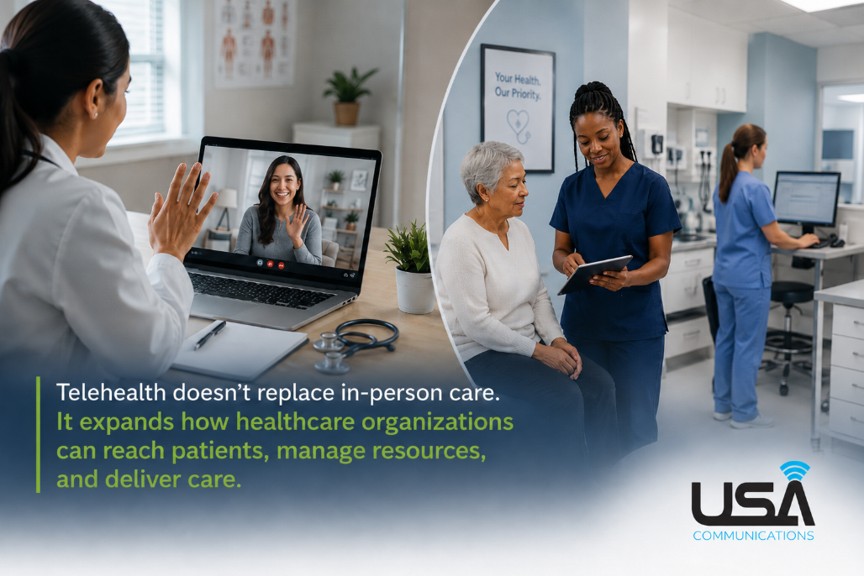
Telehealth doesn’t replace in-person care. It expands how healthcare organizations can reach patients, manage resources, and deliver care.
The opportunity now is to take what worked during COVID and make it better.
Telehealth should support the way a practice delivers care, not create another layer of frustration.
Start With a Technology Assessment
If telehealth is part of the way your organization delivers care, it may be worth reviewing the technology supporting it.
A Technology Assessment can help identify whether your connectivity, communications platforms, backup options, and supporting infrastructure still meet the needs of your providers and patients.
The goal is not to replace technology just because something newer exists.
It is to make sure the technology you rely on continues to support a reliable, convenient, and secure patient experience.