
Healthcare AI Compliance is becoming an increasingly important part of technology planning as healthcare organizations look for ways to automate repetitive work, improve patient communication, and help already-busy staff do more without simply adding headcount.
AI can absolutely help with that.
But just because a tool can automate a process does not mean it should be given unlimited access to patient information, connected to every system, or placed between patients and staff at every step.
The goal should be to use AI where it improves the experience for both employees and patients while still protecting sensitive information and maintaining appropriate oversight.
AI Can Take Repetitive Work Off Healthcare Staff
One healthcare organization we worked with wanted to improve how its appointment team handled growing call volume without continuing to add more employees.
Their contact center already handled a large number of patient interactions, so the goal was not to replace the staff they had. It was to help those employees manage the workload more efficiently.
AI could assist with routine scheduling, gather basic information, summarize calls, identify important details from conversations, and integrate information back into the systems staff were already using.
That kind of automation can be valuable because it removes repetitive work while allowing employees to focus on patients who actually need a person.
But that does not mean every interaction should be handed over to AI.
Patients Still Want the Option to Reach a Person
We also worked with a healthcare practice that had introduced an AI receptionist to help manage incoming patient calls.
At first, the AI agent was doing too much.
Patients were being pushed through longer automated interactions when many of them simply wanted to reach the right department or speak with someone directly. The technology itself worked, but the experience was creating frustration, and patient retention was becoming a concern.
Instead of removing AI completely, we stepped back and looked at which parts were actually improving the patient experience.
One of the most useful features turned out to be intelligent call routing.
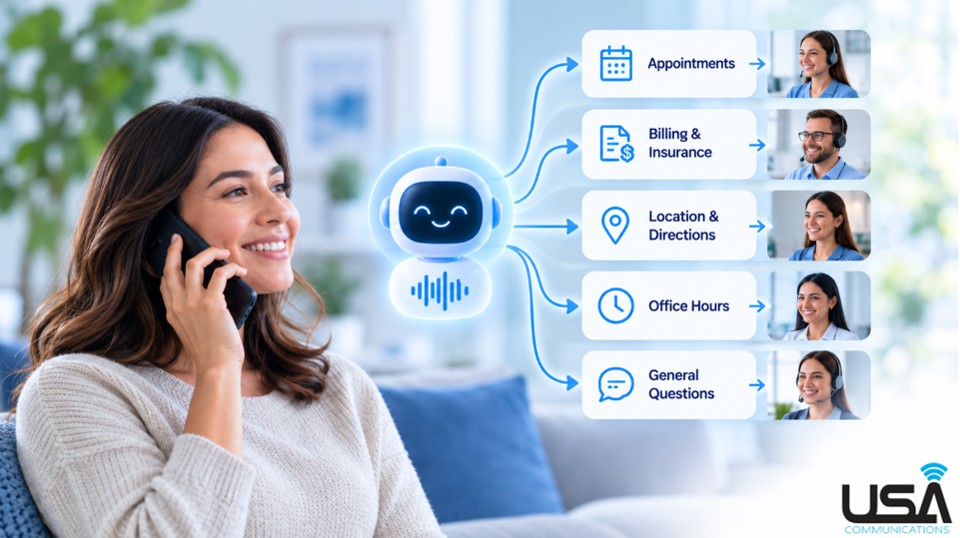
Rather than making every caller listen through a long traditional phone menu, the AI receptionist could speak naturally with the patient and understand what they needed. A caller could say they had a billing question, needed to schedule an appointment, wanted office hours or a specific location, or had a general question for the doctor.
The AI could then route that patient to the appropriate department without trying to handle the entire interaction itself.
That change made a big difference.
We moved away from some of the more aggressive automation while keeping the pieces that genuinely made the process easier. Patients had a faster path to the right person, staff received better-routed calls, and the AI still reduced unnecessary friction without becoming a barrier between the patient and the practice.
Patients do not care that a system uses AI. They care whether it makes their experience easier.
AI does not have to be all or nothing. The most effective strategy may be keeping the parts that improve the workflow and removing the parts that create frustration.
Where AI Can Add Real Value
Healthcare organizations are already finding practical ways to use AI without trying to automate the entire patient experience.
Some of the most useful applications include:
- Appointment scheduling and rescheduling
AI can help patients find available times, make routine changes, or handle simple appointment requests without requiring staff to manage every interaction manually. - Call summaries and documentation
AI can summarize patient conversations and help staff capture important information without requiring someone to listen back to an entire recording. - AI-assisted contact centers
AI can help route calls, identify why someone is calling, surface relevant information, and support employees during patient interactions. - After-hours communication
AI can handle basic questions or scheduling requests when the office is closed while still providing an option to escalate when appropriate. - Reducing repetitive administrative work
Routine follow-ups, reminders, basic information gathering, and other predictable tasks can often be automated so staff can focus on higher-value work.
The important part is choosing where AI actually improves the workflow instead of adding it simply because the feature is available.
The More Information AI Can Access, the More Carefully It Should Be Reviewed
The compliance conversation becomes even more important when AI is connected to patient information, EHR systems, contact centers, scheduling platforms, or other systems containing sensitive data.
Some integrations may create very little additional value while requiring the AI platform to access significantly more patient information.
That tradeoff deserves careful consideration.
Before implementing an AI tool, healthcare organizations should understand exactly what information the platform needs, where that information goes, and how it is protected.
The question is not only what AI can do for your healthcare organization, but what information it needs access to in order to do it while staying compliant.
Questions to Ask Before Connecting AI to Patient Workflows
Before turning on another AI feature or connecting a new platform, healthcare organizations should review a few basic questions:
- What patient information does the AI actually need access to?
- Where is that information stored and processed?
- Does the vendor handle protected health information?
- What agreements and safeguards are in place with the vendor?
- Who inside the organization can access AI-generated summaries or data?
- Does the AI need access to the full patient record, or only limited information?
- Can patients easily reach a human when the AI cannot help them?
- Are employees using approved AI platforms, or entering patient information into public AI tools?
- What happens when the AI gives an incorrect response or misunderstands a patient?
- Is the benefit of the integration worth the additional access being granted?
Those questions should be answered before the technology becomes part of the daily workflow.
AI Should Support Staff, Not Create New Problems
AI can be a powerful tool for healthcare organizations trying to manage increasing workloads, improve accessibility, and make better use of the employees they already have.
But the most successful implementations are not necessarily the ones using the most AI.
They are the ones using it intentionally.
AI should make routine work easier, give staff more time for meaningful patient interactions, and improve the experience for patients who choose to use it.
It should not make patients feel trapped in automation, give systems unnecessary access to sensitive information, or create new compliance concerns that outweigh the benefit.
USA Communications helps healthcare organizations evaluate communication platforms, AI tools, integrations, contact center technology, and the infrastructure supporting those systems.
A Free Technology Assessment can help identify where AI may improve your workflow, where human interaction still matters most, and whether the technology being considered fits the way your organization actually operates.